A tile shower that leaks is almost never a tile problem. It's a waterproofing problem that got covered up. These are the three ways a shower wall gets built around here, and how we pick.
GoBoard
GoBoard is a rigid foam panel made by Johns Manville, with a fiberglass facing on both sides. The foam itself doesn't absorb water, so the panel is the substrate and the waterproofing in one. You screw it to the studs, seal every seam and screw head with the joint tape and sealant, and tile straight onto it.
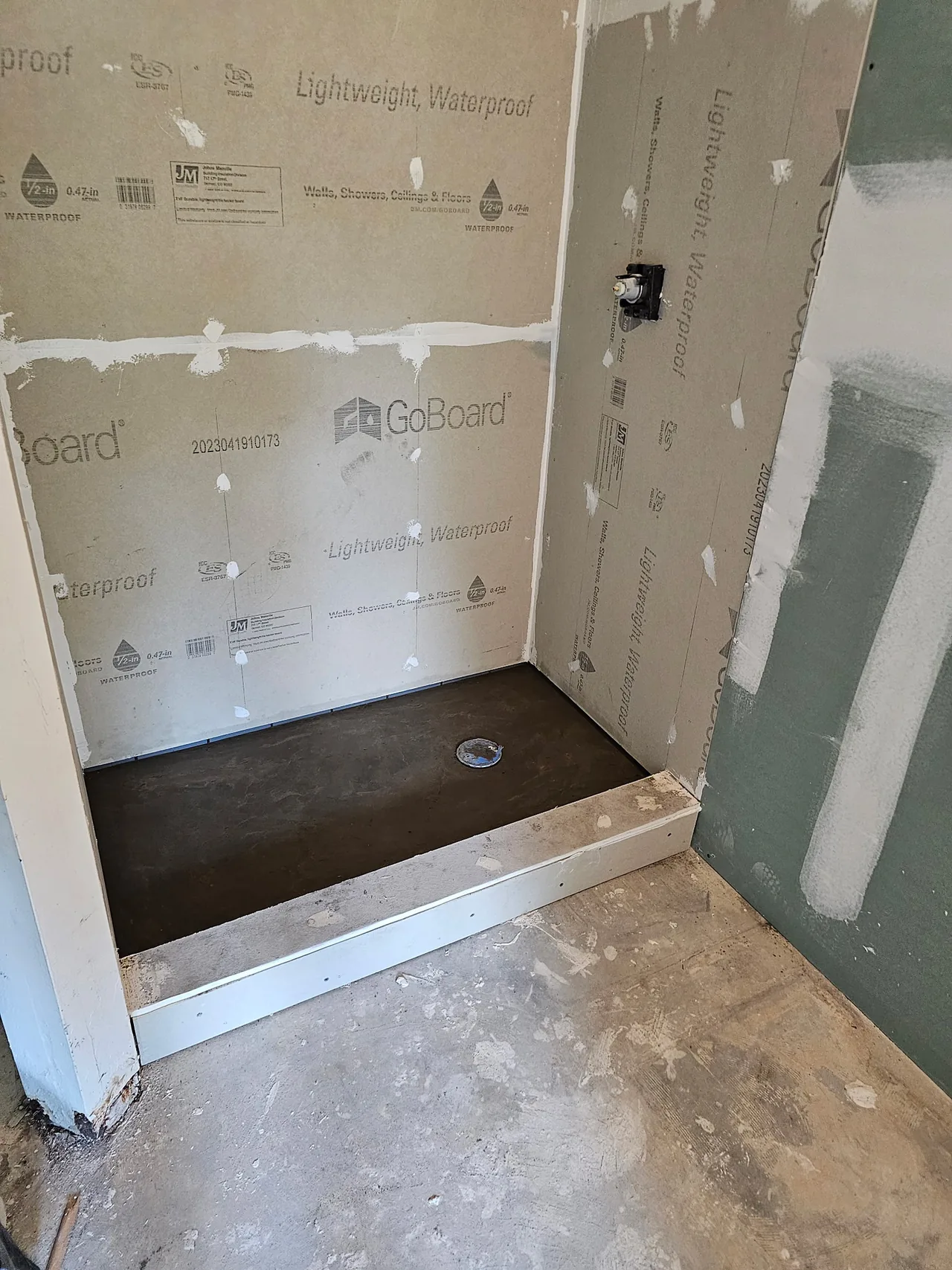
It's light, it cuts with a utility knife, and on a standard three-wall shower with plumb studs you can board, seal and be ready for tile in a day. Fewer products, fewer steps, fewer places to miss.
This is our default for most residential showers. A tub-to-shower conversion, a simple alcove, a rectangular walk-in with a pre-sloped pan. GoBoard gets you to a waterproof, tile-ready wall without anything to wait on.
Schluter KERDI
KERDI is a thin orange sheet membrane. It goes over a substrate, usually KERDI-BOARD or cement board, set into thinset. Every seam, inside corner and pipe penetration gets KERDI-BAND or a preformed piece, also set in thinset. Then tile goes over the membrane.
What KERDI has that GoBoard doesn't is the ecosystem. The KERDI-DRAIN bonds the floor membrane to the drain, which is the most vulnerable spot in any shower. KERDI-LINE gives you a linear drain for a curbless shower. There are preformed niches and shelves that waterproof in minutes. And because the membrane sits in a bed of thinset, it forgives walls that aren't perfectly flat.
We use KERDI when the layout earns it: curbless or zero-threshold showers, steam showers, wet rooms, showers with several niches, odd angles, or anywhere a documented, flood-tested system is specified. The Sanford bath on our projects page got KERDI over DensShield on the walls, with a mortar pan and a DITRA uncoupling membrane on the floor.
Cement board with a liquid membrane
Cement board on its own is moisture-resistant, not waterproof. Water that gets through the grout goes through the board and into the framing. To make it a shower wall, it needs a liquid membrane rolled over it, like RedGard, in enough coats to hit the right thickness, with every corner and screw head covered.
Done carefully, it works. The problem is that "done carefully" is doing all the work in that sentence. Thin spots and missed corners don't show up until the wall behind them is rotten. We use this approach mainly when cement board is already in place and in good condition, and on lower-exposure areas like a tub surround.
What all three need
- Solid framing. Studs on 16-inch centers with no flex. A wall that moves cracks grout, and cracked grout is where water gets in.
- Every seam and every fastener sealed. On GoBoard that's tape and sealant. On KERDI it's KERDI-BAND in thinset. Skip one screw head and you've built a drain into your wall.
- The right thinset. Schluter specifies which mortars go under and over KERDI: unmodified thinset, or its own SET and ALL-SET mortars. A random modified thinset from the shelf is a common mistake. Follow the installation handbook for the assembly you're building.
- The drain done right. Most leaks are at the floor, where the pan meets the drain.
- A flood test before tile goes on, so a problem gets found while it's still cheap.
The brand matters less than the installer. A KERDI shower thrown together will leak. A GoBoard shower built carefully will last decades.
Cost
GoBoard panels usually run less than KERDI-BOARD, and the system has fewer parts. On a standard shower the material difference is modest, and it shrinks once you add KERDI accessories for a complicated layout. Labor is similar in experienced hands. GoBoard is a little faster on simple showers. KERDI takes longer to get right, which is also why it's the choice for the complicated ones.
Written by James from our own installs. Product details (mortar compatibility, joint treatment, steam-shower suitability, cure times) follow the manufacturers' current instructions, which change; check the Schluter and Johns Manville documentation for the assembly you're building.